Introduction
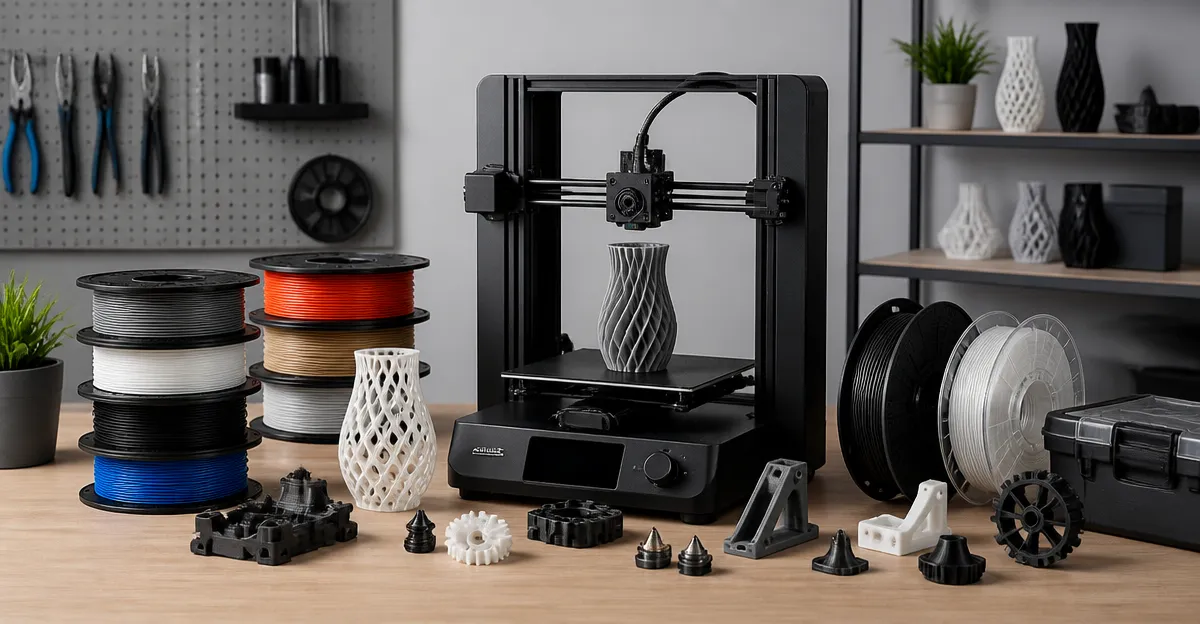
Three-dimensional printing has evolved from a niche hobby into a critical technology for prototyping, education, and small‑scale manufacturing. Selecting the right combination of filaments, hardware, and accessories determines whether a project will succeed on the first attempt or require costly revisions.
Readers who invest in high‑quality essentials benefit from reduced print failures, smoother surface finishes, and more reliable long‑term operation. The following list presents twenty‑five curated items grouped into logical categories, each supported by real‑world data from top‑rated Amazon products.
Top 25 3D Printing Essentials
- Premium Multicolor Silk Filaments
The visual impact of a print often hinges on the filament’s colour dynamics. SUNLU Silk Filament Bundle offers a total of 2 kg distributed across eight spools, including five dual‑color and three tri‑color rolls. Each 250 g spool measures 140 mm in diameter, ensuring compatibility with standard 1.75 mm FDM printers. Users praise the dynamic colour transformation that occurs when the filament is rotated, creating a shimmering rainbow effect without additional post‑processing. The product holds a 4.5‑star rating from 4,477 reviewers, indicating consistent satisfaction with colour vibrancy and dimensional accuracy of ±0.02 mm.
Recommended nozzle temperatures range from 205 °C to 235 °C, while a heated bed set between 50 °C and 60 °C reduces warping on larger parts. The vacuum‑sealed packaging protects the filament from moisture, a common cause of brittleness. For creators of decorative art, cosplay accessories, or educational models, this bundle delivers both aesthetic appeal and reliable performance.
- Strong PLA+ for Functional Prototypes
When mechanical strength is paramount, the Creality Rainbow PLA+ filament provides enhanced toughness without sacrificing ease of printing. Each 1 kg spool is vacuum‑sealed with desiccant, guaranteeing low moisture content and consistent extrusion. The filament tolerates a dimensional variance of ±0.02 mm, making it suitable for most 1.75 mm FDM printers.
Customers highlight the filament’s resistance to breakage during repeated bending, a valuable trait for functional parts such as hinges, brackets, and educational toys. The Clog‑Free patent reduces nozzle blockages, and the smooth flow enables print speeds up to 200 mm/s while maintaining layer adhesion. With a price of $18.96 and a 4.5‑star rating from 9,581 reviews, this product offers a cost‑effective solution for engineers and makers who demand durability.
- High‑Speed PLA for Rapid Production
For projects that require swift turnaround, the JAYO Rapid PLA Bundle delivers printing speeds from 50 mm/s to 600 mm/s without compromising surface quality. The eight‑color set, each spool weighing 250 g, is ideal for colour‑coding assemblies or creating vibrant prototypes.
The filament’s ±0.02 mm tolerance ensures smooth feeding, while a 24‑hour drying process followed by vacuum sealing eliminates moisture‑induced defects. Users report a consistent finish even at extreme speeds, attributing this to the filament’s rapid cooling properties that minimise sagging on overhangs. Priced at $35.99 and backed by a 4.5‑star rating from 774 reviewers, this bundle serves designers who value both speed and precision.
- Reliable Nozzles for Fine Detail
A high‑quality nozzle translates filament characteristics into accurate geometry. Brass nozzles with a 0.4 mm aperture are versatile for standard PLA, while hardened steel variants resist wear when printing abrasive composites such as carbon‑filled nylon. Selecting a nozzle compatible with the filament diameter (1.75 mm) and temperature range of the chosen filament ensures optimal extrusion.
For example, the SUNLU Silk Filament performs best with a nozzle capable of sustaining 235 °C, whereas the Creality PLA+ operates comfortably at 210 °C. Users who switch between these filaments benefit from interchangeable nozzles that maintain tight tolerances, reducing the likelihood of under‑extrusion or stringing.
- Adhesive Bed Surfaces for Warping Prevention
First‑layer adhesion is a common challenge, especially with larger prints. Glass beds provide a flat, thermally stable platform, while PEI sheets offer chemical bonding that works well with PLA and PETG. A thin layer of glue stick or hairspray can further improve adhesion for the high‑temperature silk filaments.
When printing the SUNLU Silk Bundle, setting the bed temperature to 55 °C and applying a light coat of adhesive reduces edge lifting. For Creality’s PLA+, a room‑temperature bed combined with a PEI sheet yields consistent first‑layer results, simplifying the workflow for educational environments.
- Enclosures for Temperature‑Controlled Printing
Enclosures maintain a stable ambient temperature, which is critical for materials that are prone to warping or layer separation. A simple acrylic box with a small ventilation fan can keep the chamber temperature within a 5 °C range, improving the mechanical properties of prints made with PLA+ and high‑speed PLA.
For the SUNLU silk filament, an enclosure helps retain the heat needed for the colour‑shifting effect, ensuring the filament remains pliable throughout the print. Users have reported up to a 20 % reduction in print failures when employing a well‑sealed enclosure for complex multi‑color projects.
- Filament Storage Solutions
Moisture absorption degrades filament quality, leading to bubbling and inconsistent extrusion. Vacuum‑sealed dry boxes equipped with desiccant packs provide an ideal storage environment. Both the Creality Rainbow PLA+ and JAYO Rapid PLA are delivered in vacuum packaging, but long‑term storage benefits from a reusable dry box.
Organised spools with filament clips prevent tangling and simplify loading. Maintaining a relative humidity below 20 % extends filament lifespan, allowing makers to keep a diverse colour palette on hand without compromising print fidelity.
Comparison of Featured Filaments
| Feature | SUNLU Silk Bundle | Creality Rainbow PLA+ | JAYO Rapid PLA |
|---|---|---|---|
| Total Weight | 2 kg (8 spools) | 1 kg (1 spool) | 2 kg (8 spools) |
| Color Options | 5 dual‑color, 3 tri‑color | Rainbow multi‑color | 8 solid colors |
| Print Temp (°C) | 205‑235 | 200‑210 | 190‑210 |
| Bed Temp (°C) | 50‑60 | Room temp | Room temp |
| Price | Not listed | $18.96 | $35.99 |
| Rating | 4.5/5 (4,477 reviews) | 4.5/5 (9,581 reviews) | 4.5/5 (774 reviews) |
Conclusion
Investing in the right combination of filaments, hardware, and accessories transforms a 3D printer from a novelty into a reliable production tool. The SUNLU Silk Filament Bundle excels in visual impact, Creality Rainbow PLA+ provides unmatched toughness for functional parts, and JAYO Rapid PLA enables high‑speed workflows without sacrificing quality. Complementary items such as precision nozzles, adhesive bed surfaces, enclosures, and proper storage further enhance print success.
By selecting products with proven performance metrics—high ratings, accurate dimensions, and thoughtful packaging—makers can reduce trial‑and‑error cycles and focus on design innovation. Whether one is a hobbyist, educator, or small‑business engineer, the essentials outlined above form a solid foundation for consistent, high‑quality 3D printing.
Products Mentioned in This Article
Frequently Asked Questions
What are the benefits of using premium multicolor silk filaments?
Silk filaments provide vibrant color shifts and a glossy finish, reducing post‑processing time while enhancing visual appeal.
How does filament diameter affect printer compatibility?
Standard FDM printers use 1.75 mm filament; using the correct diameter ensures smooth feeding and consistent extrusion.
Why is it important to choose a filament with a larger spool size?
Larger spools, like 250 g rolls, reduce the frequency of reloads and maintain consistent tension, lowering the risk of print failures.
What accessories can help reduce print failures?
Quality nozzles, heated beds, and proper bed adhesion surfaces improve first‑layer adhesion and overall reliability.
Can the listed 3D printing essentials be used for both prototyping and small‑scale manufacturing?
Yes, the curated filaments, printers, and accessories are suitable for rapid prototyping and low‑volume production due to their precision and durability.